
Case study
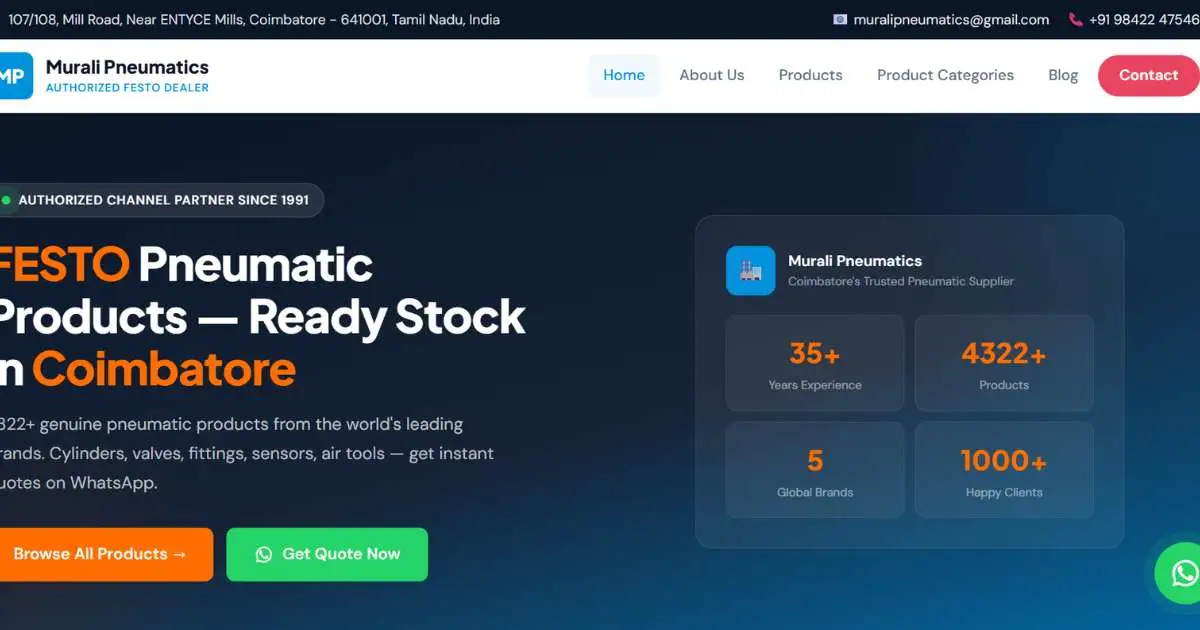
A Listing Is Not a Datasheet — Murali Pneumatics Case Study
Results
At a glance
| Client | Murali Pneumatics, Coimbatore |
| Business | Authorised Festo channel partner — pneumatic cylinders, valves, fittings, sensors, air tools, lubrication systems |
| Channel partner since | 1991 |
| Website | muralipneumatics.co.in |
| Brands | Festo, IEC Air Tools, APT Pneumatic, Dropco/KRS, Hendo Industries |
| Catalogue size | 432+ products online, from a manufacturer range in the thousands |
| Depth per product | Up to 58 specification rows, plus applications and compatible accessories |
| Response commitment | WhatsApp quote in 30 minutes |
| Platform | WordPress + WooCommerce, hand-coded theme, catalogue mode |
| Built by | BRUsoft, Coimbatore |
The client
Murali Pneumatics has been an authorised Festo channel partner in Coimbatore since 1991, supplying pneumatic components to industry across Tamil Nadu from ready stock on Mill Road.
Its buyers are specifiers. A design engineer building a machine, a maintenance head standardising a plant, a systems integrator scoping a project — people who arrive with an order code or with a set of constraints, and who need to be certain before they commit.
The problem: a listing is not a datasheet
Most dealer product pages carry a photograph, a model name, a two-line description and a contact button. That is a listing. It works for a buyer who has already decided.
A specifier has not decided. Before ordering a cylinder he needs to know the bore, the stroke, the cushioning, the mounting interface, the operating pressure range, the ambient temperature limits, the seal material, whether it is ATEX rated and to which zones, and what accessories it takes. If the page does not answer those, he opens the manufacturer’s catalogue in another tab — and once he is there, the dealer has become a phone number rather than a source.
The dealer’s page has to be good enough that the buyer never leaves it. Which means it has to approach the depth of a datasheet, on every single product.
That is easy to say for ten products. The problem is doing it for hundreds, at a standard that does not visibly degrade after the first twenty.
What we built
A ten-section product page
Every product follows a fixed structure, deep enough that a specifier can complete his decision without leaving:
- Short description with the manufacturer part number stated up front
- A summary specification table
- Full product description in prose
- Key features
- A complete technical specification table — on some products running past fifty rows
- Common applications, written as real situations rather than categories
- Compatible accessories
- Why buy from an authorised dealer
- Enquiry routes — WhatsApp and a written form
- Related products from the same series
The specification tables are the part that does the most work, and not only for people. Attribute-and-value rows are the most reliably extractable format there is — a table row saying Nominal flow rate: 530 l/min is an unambiguous fact, where the same information inside a paragraph is an inference. When someone asks an AI assistant for a 5/3 valve with G1/8 ports at 530 l/min, tables are what get read.
The order code runs through everything
For industrial search, the manufacturer part number is the query. So it appears in every layer of the page rather than only in the description:
Title:    Festo DFPC-80-80-D – Linear Valve Actuator | 80mm Stroke | Murali Pneumatics Coimbatore
Image:    festo-dfpc-80-80-d-linear-drive-process-valve-actuator-8110816.webp
SKU:      8110816
Spec row: Part number — 8110816
An engineer who searches 8110816, or DFPC-80-80-D, or Festo linear drive 80mm stroke ISO 5210 reaches the same page from three different starting points.
Image alt text written as sentences
Alt text on this site is not a keyword string. It is a description a person could read aloud:
Genuine Festo DSBC-32-80-D3-PPSA-N3 ISO profile cylinder with 32 mm bore
and 80 mm stroke. Get a quote from Murali Pneumatics, authorized Festo
dealer in Coimbatore
That serves screen readers properly, and it also means the image carries the specification into Google Images — a channel most industrial suppliers ignore entirely, and one where a buyer who cannot name a part will often start.
The pipeline that made the depth affordable
Writing ten sections and fifty specification rows by hand takes a competent person perhaps ninety minutes per product. At three hundred products that is a project nobody finishes.
The specifications themselves come from the manufacturer’s own published data. The pipeline handles structure and consistency; it does not invent numbers. On industrial components that distinction is not a nicety — a fabricated pressure rating is a safety problem, not a content problem.
An honest word about what is not in the catalogue
Festo’s range runs to many thousands of items. Three hundred are online. Rather than let a buyer conclude the dealer does not stock what he needs, the site says so plainly on the homepage and again in the footer, and turns it into an invitation: send the code for anything at all and get a quote.
It is a small piece of copy that converts the catalogue’s biggest limitation into its most valuable enquiry, because a request for something unlisted is usually a buyer who has already searched everywhere else.
Thirty minutes, treated as a design constraint
The site commits to a WhatsApp quote within thirty minutes. That promise only holds if the enquiry arrives already complete, which is why every quote button carries the product name and its page link rather than opening an empty chat.
Catalogue mode
There is no cart. Pneumatic pricing depends on quantity, project terms and the dealer’s own arrangement with the manufacturer, and a published figure would be wrong for most buyers who saw it. Availability is shown; price is a conversation.
The format that outgrew the client
The ten-section structure was designed for this catalogue. It has since become BRUsoft’s house standard.
The same format now generates product content for electrical fans and lighting, industrial fuses and switchgear, sensors and process instrumentation — across manufacturers with nothing in common except that their buyers are specifiers who need to be certain. Internally it is still called the Murali Pneumatics format, which is a fair description of where it was worked out.
That is worth stating in a case study because it is the honest measure of whether a piece of work was any good. A layout that suited one client and needed rebuilding for the next was a design. A structure that transferred to five unrelated industries was an answer to a real problem.
Results
Replace each bracket with the client’s figures before publishing, or delete this section.
| Metric | Outcome |
|---|---|
| Products online | 432+ |
| Specification rows on the deepest product pages | 58 |
| Stated WhatsApp response time | 30 minutes |
| Years as an authorised channel partner | 35 |
| WhatsApp quote requests | 40 to 70 |
| Enquiries arriving with an order code already stated | 50 approx. |
The signal to watch is how many enquiries name a part number. A buyer messaging about DFPC-80-80-D has read the page and finished deciding. One asking whether you stock Festo cylinders has not found anything yet.
Why this matters to other dealers
Depth is the defensible position. A dealer cannot out-price a marketplace and should not try. What a marketplace listing never has is the specification detail that lets a specifier finish deciding — and building that, per product, is exactly the work competitors avoid.
Put the order code everywhere. Title, URL, image filename, alt text, specification table. It costs nothing at import time and it is the single highest-value token on an industrial product page.
Automate the structure, never the facts. A pipeline should assemble and format at scale. Specifications must come from the manufacturer’s published data. On components that carry pressure ratings and temperature limits, that line is not negotiable.
Say what you do not have. Publishing a partial catalogue and admitting it produces better enquiries than implying the range is complete. The buyer who asks for something unlisted has usually already looked everywhere else.
The honest limit: this approach costs real effort to set up and only repays where buyers genuinely specify. A dealer whose customers reorder the same twenty consumables does not need fifty-row specification tables, and would be better served putting that effort into stock visibility.
Frequently asked questions
Who built muralipneumatics.co.in?
BRUsoft, a web development studio in Coimbatore, built the site and its custom WordPress theme, the ten-section product page structure, the WhatsApp quote system and the import pipeline that generates the catalogue.
Why are the product pages so long?
Because the buyers are specifiers rather than repeat purchasers. A design engineer needs bore, stroke, cushioning, mounting interface, pressure range, temperature limits, seal material and accessory compatibility before committing. A page that answers less sends him to the manufacturer’s catalogue, and the dealer stops being the source.
Is the product content written by AI?
The structure and the written sections are generated through a scripted pipeline that uses a language model, then reviewed. The specifications are not generated — they come from manufacturer data. On industrial components a fabricated pressure rating or temperature limit is a safety issue, so that boundary is strict.
Why does the site say only a few hundred products are listed?
Because the manufacturer range runs to thousands and listing all of it is not realistic. Saying so plainly, and inviting buyers to send any product code for a quote, produces better enquiries than implying the online catalogue is complete.
Why is there no price or cart on the product pages?
Pneumatic pricing depends on quantity, project terms and the dealer’s arrangement with the manufacturer. A published figure would be wrong for most buyers who saw it, so every product page ends in a WhatsApp quote request instead.
Would a specifier find enough on your product pages?
BRUsoft builds hand-coded WooCommerce catalogue websites for industrial dealers and manufacturers across Tamil Nadu — deep structured product pages, order codes carried through every layer, WhatsApp quote requests, scripted bulk cataloguing and full structured data. No page builders, no recurring theme licences, and you own the code.
WhatsApp: +91 98947 17489
Email: bala@brusoft.in
Web: brusoft.in
Figures in this case study are as reported by the client. Festo and other brand names are the trademarks of their respective owners. BRUsoft is an independent web development studio and is not affiliated with any of them.
Similar builds
Other dealers in the same position
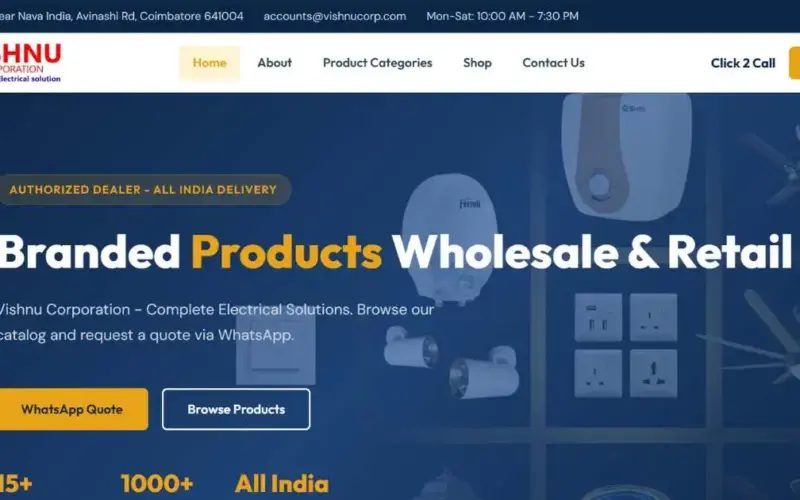
The Customer Asks in Tamil — Vishnu Corporation Case Study
At a glance Client Vishnu Corporation, Coimbatore Business Authorised dealer of branded electrical products — fans, lighting, water heaters, modular switches, wires…
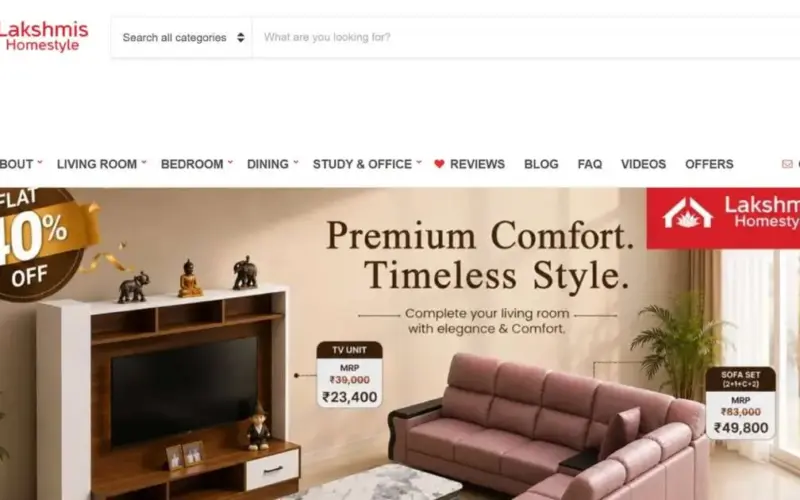
Furniture E-Commerce That Feeds a Showroom — Lakshmis Home Style Case Study
At a glance Client Lakshmis Home Style, Coimbatore Business Furniture showroom and retailer — sofas, beds, wardrobes, dining, office furniture, mattresses, carpets,…
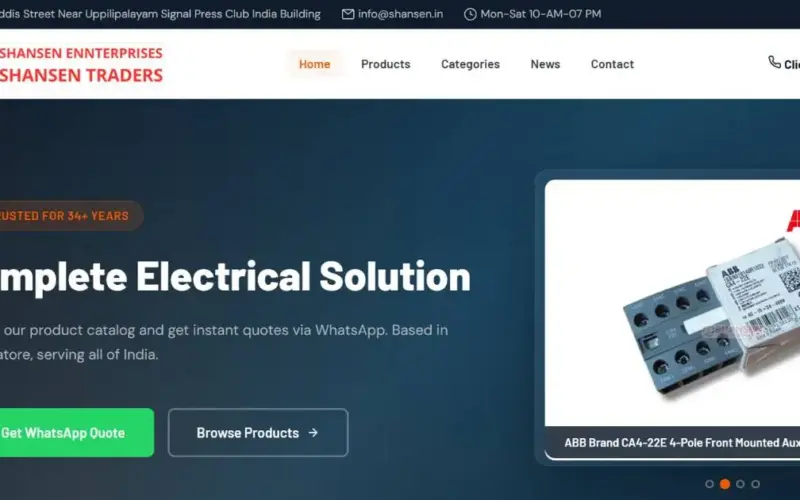
Named for the Product, Not the Company — Shansen Enterprises Case Study
At a glance Client Shansen Enterprises, Coimbatore Business Electrical products dealer — fuses, contactors, switchgear, modular switches, energy meters, cables, batteries Trading…