
Case study
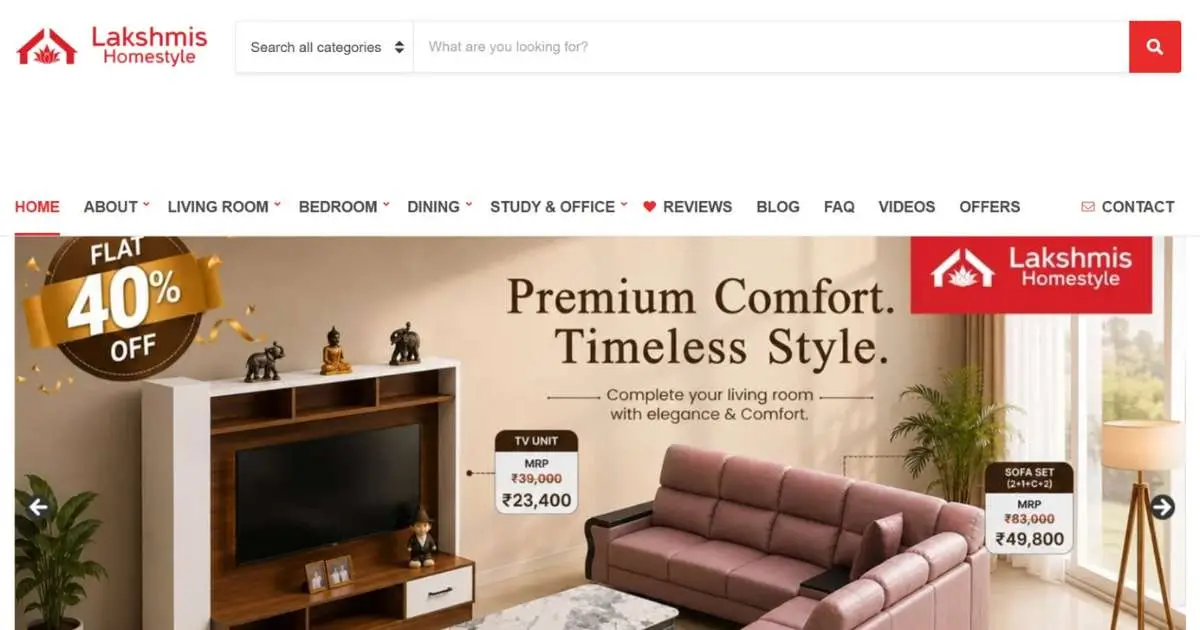
Furniture E-Commerce That Feeds a Showroom — Lakshmis Home Style Case Study
Results
At a glance
| Client | Lakshmis Home Style, Coimbatore |
| Business | Furniture showroom and retailer — sofas, beds, wardrobes, dining, office furniture, mattresses, carpets, home accessories |
| Showroom | #63 Brookebond Road, Coimbatore — open 7 days, 10:00 to 20:30 |
| Website | lakshmishomestyle.in |
| Model | Catalogue with WhatsApp quote request — no cart, no checkout, no online payment |
| Catalogue depth | 170+ categories across four browsing axes |
| Also serves | Showroom visit planning, plus a content and video library for the research phase |
| Channels | Website, WhatsApp, YouTube, Instagram, Pinterest, Facebook |
| Platform | WordPress + WooCommerce |
| Built by | BRUsoft, Coimbatore |
The client
Lakshmis Home Style is a furniture showroom on Brookebond Road in Coimbatore, open seven days a week. The range runs from sofas and teak wood cots through wardrobes, dining sets, office seating and mattresses to carpets, flower vases and wall art.
It is a considered-purchase retailer in one of the hardest categories to sell online. Which turned out to be the most useful thing to design around.
The problem: nobody buys a sofa from a photograph
Furniture resists e-commerce in a way most categories do not. A customer spending eighty thousand rupees on a teak dining set wants to sit at it, open the drawer, run a hand along the finish and judge whether the colour matches a room they are picturing. No product photograph settles that.
The obvious conclusion — that a furniture retailer therefore does not need much of a website — is exactly wrong.
Because while almost nobody buys a sofa from a photograph, almost everybody now chooses which sofas to go and see from photographs. The shortlist is built at home, on a phone, usually in the evening, often by two people scrolling together. By the time anyone walks into a showroom, the decision has narrowed from a category to three or four specific pieces.
So the site’s job is not to replace the showroom visit. It is to make sure the visit happens, and that the customer arrives already knowing what they came for. That reframing drove every decision below.
What we built
Four ways to browse, because furniture buyers do not agree
Ask five people to find a dining table and you will get five different search behaviours. The catalogue is therefore navigable along four independent axes, over the same products:
| Axis | Examples |
|---|---|
| By room | Living Room · Bedroom · Dining · Study & Office — for the customer furnishing a space rather than replacing an item |
| By type | Sofas · Recliners · Cots · Wardrobes · Centre Tables · TV Units · Shoe Racks — for the customer replacing one thing |
| By material | Burma Teak · Teak · Sheesham · Mahogany · Beechwood · Rubber Wood · Engineered Wood · Marble Top — for the customer who has decided on a wood first |
| By size or configuration | 4, 6 and 8 Seater Dining · 2, 3 and 4 Door Wardrobes · Single Cots · Space Saving Dining — for the customer working to a measurement |
The material axis is the one that surprises people who have not sold furniture. In this market a substantial share of buyers start from the wood, not the object — they want Burma teak, and what it becomes is secondary. A catalogue organised only by object type makes that customer work backwards through every category to find out which pieces are available in the wood they want.
Mattresses get a fifth treatment again, organised by brand, because that is how mattresses are genuinely shopped.
Product names that carry the configuration
Sofas are listed the way customers and salespeople actually refer to them:
Sofa MOUNTANA (3+C+2)
MUSTANG 3+2 SEATER
SOFA T-23 Genuine Leather Home Theater (1MR+C+2MR+C+1MR)
That notation — three-seater plus corner plus two-seater, or manual recliner positions in a home theatre layout — is trade shorthand that has quietly become customer vocabulary. Putting it in the product title means the listing matches how someone describes what they are looking for when they type it, and it removes ambiguity before anyone drives to the showroom.
A catalogue, not a checkout
There is no cart. Every route through the catalogue ends in a WhatsApp conversation or a showroom visit, and that is deliberate rather than a limitation.
Furniture retail in this market does not close in a checkout. Delivery scheduling, assembly, fabric and finish options, quantity on a full bedroom set, exchange of an old piece, and the negotiation that customers here reasonably expect on a large purchase — none of that survives being reduced to a single price and a payment button. A checkout on this catalogue would either misrepresent the offer or collect orders the showroom would then have to unpick by phone.
So the site does the part it is genuinely good at — showing the range, narrowing the choice, and handing over a customer who already knows what they want to talk about.
The enquiry carries the page it came from
When a customer opens WhatsApp from the site, the message is pre-filled with the page they were on:
Hello!

*From URL:* https://lakshmishomestyle.in/product/...
It looks like a small thing. It means the showroom team opens a conversation already knowing whether this person was looking at recliners or at wardrobes, before a word is exchanged. For a retailer whose staff are on the floor with customers, arriving at a conversation pre-briefed is the difference between a useful reply in two minutes and a round of questions.
A content layer, not just a catalogue
Furniture buying has a long consideration window, and during that window people research rather than shop. The site carries a genuine editorial layer for that phase — long-form guides on carpet types and materials, on dressing tables, on bedside table styling — alongside a video library and an active YouTube channel.
This is what captures the customer who is eight weeks from buying and is currently only asking what sheesham is, or whether a hydraulic storage cot is worth it. A pure product catalogue has nothing to offer that person and loses them to whoever does.
Pinterest and Instagram carry the same weight here that they would not for an industrial supplier. Furniture is one of the few categories where visual social platforms are genuinely a discovery channel rather than a branding exercise.
The showroom treated as the destination
Opening hours, the seven-day week, the phone numbers, the WhatsApp line and a correctly pinned map all sit prominently rather than being filed away on a contact page. The site is measured by whether people arrive, so the information needed to arrive is never more than a scroll away.
Results
| Metric | Outcome |
|---|---|
| Product categories live | 170+ |
| Browsing axes over one catalogue | 4 |
| Showroom days per week | 7 |
| WhatsApp enquiries | 40 to 60 per week |
| Customers arriving with a shortlist already chosen | 30 to 40 – rough share, as reported by showroom staff |
| Showroom visits attributed to the website | 60{62e089ab412b3c67441daafed38f5305d7c27168e2f25961df30aefa16a833d0} – as reported by showroom staff |
For a retailer in this category the interesting number was never online conversion. It is how many customers walk in naming a specific piece they saw on the site. That is the metric the whole design serves, and it is one only the showroom floor can report.
Why this matters to other showroom retailers
Plenty of showroom businesses in Coimbatore are still deciding whether a website is worth it, usually framed as a question about online sales. That is the wrong question.
Decide what the site is for before deciding what it should do. If the purchase genuinely closes in person — furniture, flooring, jewellery, appliances, bridal — then the site is a shortlisting tool, and it should be judged on qualified footfall rather than on cart conversion. Building it as a pure online shop and then concluding e-commerce does not work for your category is a diagnosis error.
Let customers browse the way they think. Room, object, material, size and brand are all legitimate starting points, and forcing everyone through one of them loses the rest. Multiple taxonomies over one product set cost nothing per product and serve every entry point.
Serve the research phase, not just the buying phase. In long-consideration categories, the customer who is two months out is the one you can still influence. Content is how you reach them; a catalogue alone cannot.
The honest caveat: this only pays back if the range is deep and genuinely photographed, and if someone maintains the content layer. A thin catalogue with a neglected blog is worse than a good single-page site with clear directions and hours.
Frequently asked questions
Who built lakshmishomestyle.in?
BRUsoft, a web development studio in Coimbatore, built and maintains the site — the WooCommerce store, the multi-axis category structure, the WhatsApp enquiry integration and the content and video sections.
Why is there no cart or checkout on the site?
Because furniture does not close in a checkout. Delivery scheduling, assembly, fabric and finish choices, exchange of an old piece and the negotiation customers expect on a large purchase all need a conversation. Every product page ends in a WhatsApp quote request or a showroom visit instead.
Why is the catalogue organised by wood type as well as by furniture type?
Because a significant share of buyers in this market start from the material. Someone who has decided on Burma teak wants to see everything available in Burma teak, and a catalogue organised only by object forces them to check every category one at a time.
Why does a furniture retailer need a blog and video library?
Because furniture has a long consideration window. A customer two months from purchase is researching materials and styles rather than shopping, and a product catalogue has nothing to offer them. Guides and videos reach that customer while the decision is still open.
Should a showroom business measure its website by online sales?
Usually not, if the purchase closes in person. The more meaningful measure is how many customers arrive at the showroom already naming a specific piece they found online. Judging a shortlisting tool by cart conversion leads retailers to conclude e-commerce does not work for their category, when the site was simply built for the wrong job.
How does BRUsoft decide between a catalogue and a full online store?
By how the category actually transacts. Where price depends on configuration, delivery, quantity or negotiation — industrial components, furniture, made-to-order goods — a catalogue ending in a quote request reflects reality and a checkout does not. Where the product ships at a fixed published price, a full store is the right build.
Does your showroom have a website built for the wrong job?
BRUsoft builds WordPress and WooCommerce sites for retailers and industrial businesses across Tamil Nadu — catalogue sites and transactional stores, multi-axis category structures, WhatsApp integration, content and video sections, and full structured data. Built to suit how your category actually sells.
WhatsApp: +91 98947 17489
Email: bala@brusoft.in
Web: brusoft.in
Figures in this case study are as reported by the client. Brand names referenced are the trademarks of their respective owners. BRUsoft is an independent web development studio.
Similar builds
Other dealers in the same position
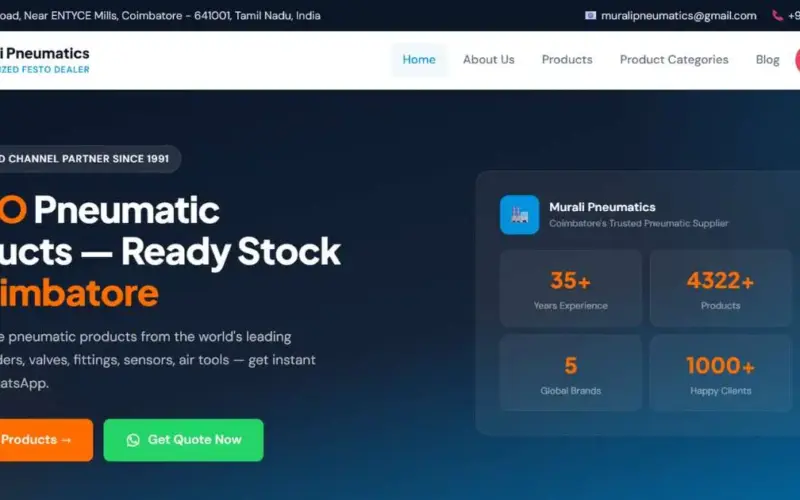
A Listing Is Not a Datasheet — Murali Pneumatics Case Study
At a glance Client Murali Pneumatics, Coimbatore Business Authorised Festo channel partner — pneumatic cylinders, valves, fittings, sensors, air tools, lubrication systems…
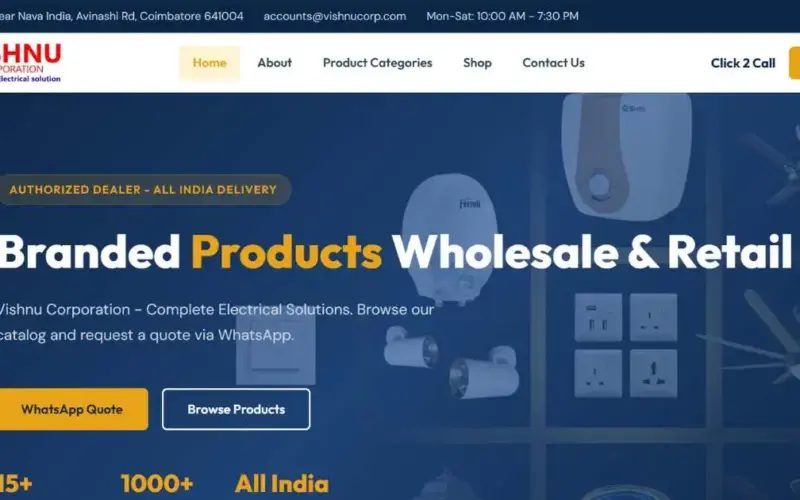
The Customer Asks in Tamil — Vishnu Corporation Case Study
At a glance Client Vishnu Corporation, Coimbatore Business Authorised dealer of branded electrical products — fans, lighting, water heaters, modular switches, wires…
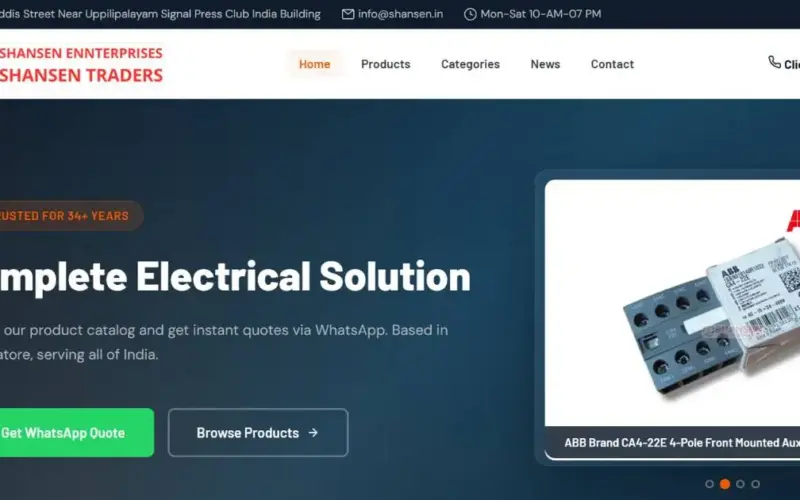
Named for the Product, Not the Company — Shansen Enterprises Case Study
At a glance Client Shansen Enterprises, Coimbatore Business Electrical products dealer — fuses, contactors, switchgear, modular switches, energy meters, cables, batteries Trading…