
Case study
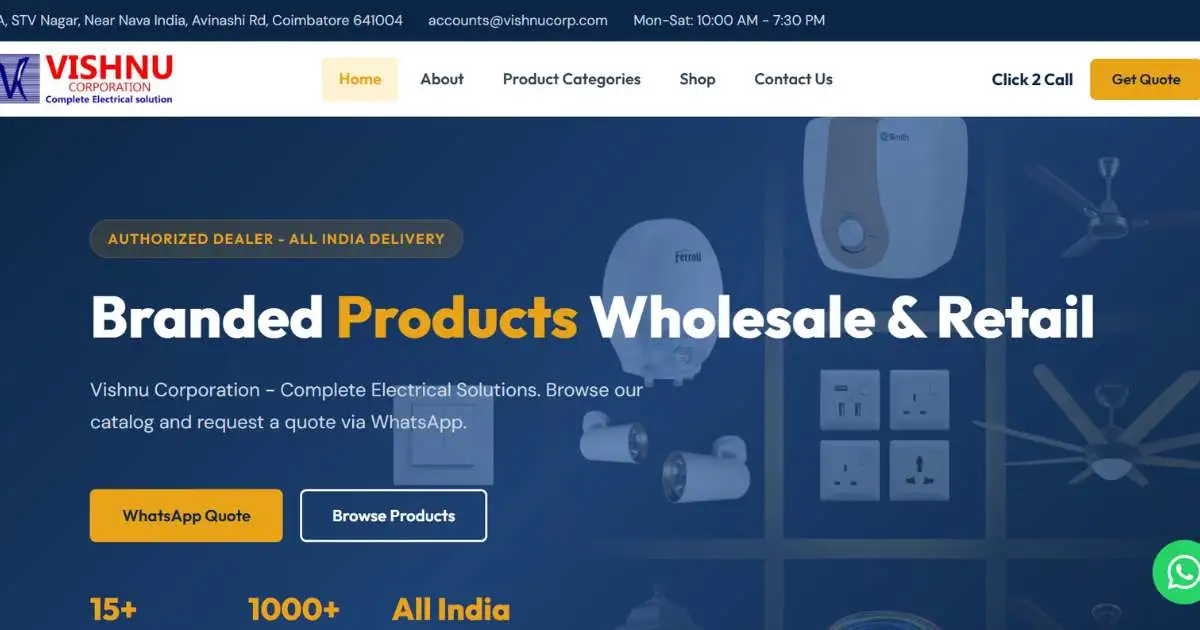
The Customer Asks in Tamil — Vishnu Corporation Case Study
Results
At a glance
| Client | Vishnu Corporation, Coimbatore |
| Business | Authorised dealer of branded electrical products — fans, lighting, water heaters, modular switches, wires and cables, PVC pipes |
| Website | coimbatoreelectricals.com |
| Brands carried | 15+, including Crompton, Havells, Almonard, Wipro, Legrand, Honeywell, Polycab, RR Kabel, Racold, AO Smith, Pasolite |
| Catalogue size | 480+ products |
| Serves | Retail customers and wholesale buyers — electricians, contractors, builders, project dealers |
| Languages | English and Tamil, on every product page |
| Delivery | Coimbatore, Tamil Nadu and kerala |
| Enquiry channels | WhatsApp, email and click-to-call, all pre-filled per product |
| Platform | WordPress + WooCommerce, hand-coded theme, catalogue mode |
| Built by | BRUsoft, Coimbatore |
The client
Vishnu Corporation is an authorised dealer of branded electrical goods on Avinashi Road in Coimbatore, carrying more than fifteen manufacturers across fans, lighting, water heaters, switches, wires and pipes. It sells wholesale and retail from the same counter, and delivers across India.
Its customers are a homeowner replacing one bedroom fan, an electrician sourcing forty for a housing block, and a shop owner who wants to know whether a wall fan will suit a kitchen with no floor space. All three arrive through the same website.
The problem: the counter conversation does not survive online
What an authorised dealer actually sells, beyond the product, is the conversation at the counter.
Someone walks in holding a rough idea — a fan for a hall, a geyser for a bathroom — and leaves with a specific model, because someone behind the counter asked how big the room was, what the budget looked like, and whether they wanted a remote. That exchange is thirty years of accumulated knowledge, and it is the whole reason to buy from a dealer rather than from a marketplace listing.
Almost none of it survives the move online. A typical dealer product page shows a photograph, a model name and a price, which is exactly what a marketplace shows, only with less traffic. The dealer competes on the one dimension where he cannot win and abandons the one where he cannot be beaten.
And there is a second problem underneath it, specific to this market and usually ignored.
The decision that shaped the site: the customer asks in Tamil
A significant share of buyers in Coimbatore — homeowners, electricians, small shop owners — think and ask in Tamil. At the counter that is unremarkable; the conversation simply happens in Tamil. Online, almost every electrical product page in India is English-only, so that customer reads a specification sheet in a second language or gives up and telephones.
So every product page on this site carries its questions and answers in both languages, paired:
Where can I buy the Havells Girik Neo in Coimbatore?
கோயம்புத்தூரில் Havells சுவர் ஃபேன்களை எங்கே வாங்கலாம்?
Not a translation widget bolted onto the page. Not machine translation applied at render time. Written answers in both languages, stored as content, indexable in both.
This matters more each year, not less. Voice search in Tamil is growing quickly, and voice queries are conversational — they look far more like a spoken question than like a typed keyword. A page carrying real Tamil questions is positioned for that. A page carrying an English spec sheet and a translate button is not.
A technical note that costs people weeks
Tamil in structured data breaks silently if the encoding is wrong. PHP’s json_encode() escapes non-ASCII characters by default, so Tamil text becomes a string of \u0b95 sequences inside the JSON-LD — valid JSON, unreadable to anything that matters. The fix is a single flag, JSON_UNESCAPED_UNICODE, and it is now standard across every BRUsoft build that touches Tamil.
What else we built
FAQs that answer rather than sell
The questions on each product are the ones actually asked across the counter, and the answers are allowed to be honest:
- Is this suitable for kitchens and small rooms? — answered with where wall fans genuinely fit, and a note to check the sweep size for the room.
- Does it come with a remote? — answered with “check this model, some do and some use a pull-cord,” rather than a claim.
- What is the warranty? — answered with the term and that it runs from date of purchase.
The homepage FAQ goes further and gives away the sizing rule outright: 1200mm sweep for bedrooms, 1400mm for halls. That is advice a competitor could copy in a minute, and publishing it is still correct — it is the clearest possible demonstration that there is someone here who knows the answer.
It also happens to be exactly the content shape that AI assistants and featured snippets consume. Writing genuinely useful answers and writing for machine extraction turn out to be the same job.
One catalogue, two price conversations
The site serves retail buyers and wholesale buyers without splitting into two sites or hiding one behind a login.
It does that by not publishing prices at all. Every product ends in a quote request, and the quantity in that request tells the dealer which conversation he is in. A homeowner asking about one fan and a contractor asking about forty get different numbers, as they always have — and neither is shown a price that is wrong for them before anyone has spoken.
Three ways to ask, all pre-filled
WhatsApp, email and click-to-call sit on every product page. Each carries the product name and its URL:
Hi, I would like to get a quote for: Havells Girik Neo Wall Fan - Black
https://www.coimbatoreelectricals.com/product/havells-girik-neo-wall-fan-black/
WhatsApp for the customer who wants an answer in minutes, email for the contractor who needs the quote in writing for a client, and a call for the person who would simply rather talk. The URL sits last in the WhatsApp message, with nothing after it — WhatsApp’s parser absorbs any following word into the link and breaks it.
A dealer SKU that survives fifteen brands
Products carry a dealer reference built to a fixed pattern rather than the manufacturer’s raw code:
HVW-GIRIKNEO-BLACKBrand prefix, model, variant. Fifteen manufacturers use fifteen incompatible numbering schemes, and a dealer stocking all of them needs one internal language. The convention also means a colour variant is a distinct, quotable, searchable item rather than a note buried in a description.
Structured data
JSON-LD covers Organization, LocalBusiness, WebSite, BreadcrumbList, Product and FAQPage, with product entities carrying brand, dealer SKU and availability. The FAQ markup is what makes the bilingual answers eligible to be surfaced directly, in either language, rather than sitting unread at the bottom of a page.
Results
Replace each bracket with the client’s figures before publishing, or delete this section.
| Metric | Outcome |
|---|---|
| Products live in catalogue | 480+ |
| Brands consolidated into one source | 15+ |
| Languages on every product page | 2 |
| WhatsApp enquiries | 20 to 30 Per day |
| Share of enquiries arriving with a specific model named | 10 to 15 |
| Wholesale vs retail enquiry split | 30:70 |
The number worth watching is how many enquiries name a specific model. A buyer who messages asking about the Girik Neo in black has already been served by the site. One who messages asking “do you have wall fans” has not.
Why this matters to other dealers
Publish the advice, not just the catalogue. The knowledge behind the counter is the only thing a marketplace cannot copy, and keeping it off the website concedes the one advantage a dealer has. Answering the questions customers actually ask — including the ones where the honest answer is “it depends, check the model” — costs a competitor nothing to imitate and still works, because most will not bother.
Write in the language your customers think in. Not a translate button, which search engines largely ignore and customers rarely find. Real content, stored and indexed. In Tamil Nadu this is close to an open goal: the competition is almost entirely English-only, and the customers are not.
Let quantity, not a price table, sort your buyers. A dealer serving wholesale and retail does not need two sites or a trade login. A quote request tells you which customer you have as soon as they name a number.
The honest caveat: bilingual content only works if it is genuinely written. Machine-translated Tamil reads badly to a Tamil speaker, and reading badly to the customer you were trying to serve is worse than not having tried. The cost is real, and it is why most dealers will not do it.
Frequently asked questions
Who built coimbatoreelectricals.com?
BRUsoft, a web development studio in Coimbatore, built the site and its custom WordPress theme, including the bilingual FAQ system, the dealer SKU convention, the multi-channel quote requests and the bulk import pipeline behind the catalogue.
Why are the product FAQs in both English and Tamil?
Because a large share of buyers in Coimbatore think and ask in Tamil, and almost every competing electrical product page in India is English-only. The answers are written content in both languages rather than a translation widget, so both versions are indexable and can be surfaced directly in search.
Does a translation plugin not achieve the same thing?
No. Translation widgets render on the client side, so the translated text is generally not indexed, and machine output reads poorly to a native speaker. Written bilingual content is indexable and reads like a person wrote it, because one did.
Why is there no price on the product pages?
Because the site serves retail and wholesale buyers from one catalogue. A homeowner buying one fan and a contractor buying forty are not looking at the same number, and publishing either would be wrong for the other. Every product ends in a quote request instead, and the quantity in that request identifies the buyer.
Why use a dealer SKU instead of the manufacturer’s code?
Because fifteen manufacturers use fifteen incompatible numbering schemes. A single internal convention gives the dealer one language across the whole catalogue, and makes each colour or size variant a distinct, quotable item.
Does BRUsoft build bilingual catalogues for other businesses?
Yes. Tamil and English content, correctly encoded in both page copy and structured data, has been built into catalogue and directory sites across Tamil Nadu.
Is your website selling what you actually sell?
BRUsoft builds hand-coded WooCommerce catalogue websites for dealers and manufacturers across Tamil Nadu — bilingual English and Tamil content, dealer SKU conventions, pre-filled WhatsApp, email and call enquiries. No page builders, no recurring theme licences, and you own the code.
WhatsApp: +91 98947 17489
Email: bala@brusoft.in
Web: brusoft.in
Figures in this case study are as reported by the client. Crompton, Havells, Almonard, Wipro, Legrand, Honeywell, Polycab, RR Kabel, Racold, AO Smith, Pasolite and other brand names are the trademarks of their respective owners. BRUsoft is an independent web development studio and is not affiliated with any of them.
Similar builds
Other dealers in the same position
A Listing Is Not a Datasheet — Murali Pneumatics Case Study
At a glance Client Murali Pneumatics, Coimbatore Business Authorised Festo channel partner — pneumatic cylinders, valves, fittings, sensors, air tools, lubrication systems…
Furniture E-Commerce That Feeds a Showroom — Lakshmis Home Style Case Study
At a glance Client Lakshmis Home Style, Coimbatore Business Furniture showroom and retailer — sofas, beds, wardrobes, dining, office furniture, mattresses, carpets,…
Named for the Product, Not the Company — Shansen Enterprises Case Study
At a glance Client Shansen Enterprises, Coimbatore Business Electrical products dealer — fuses, contactors, switchgear, modular switches, energy meters, cables, batteries Trading…