
Digital Marketing Strategy
How to Boost Your Restaurant’s Customer Base with Social Media and User-Generated Content
Published 16 Nov 2026 · Updated 16 Nov 2026 · Bala, BRUsoft
By Bala, BRUsoft · Published 16 November 2026 · About 9 minutes to read
Quick answer: User-generated content (UGC) is any photo, video, review or post that your customers create about your restaurant. To turn it into more diners: make your food and space worth sharing, ask every guest (not just happy ones) to post or review, feature the best posts with permission, reply to every review, and track calls, direction requests and bookings. Reward sharing on Instagram if you like, but never offer discounts or freebies for Google reviews.
Key takeaways
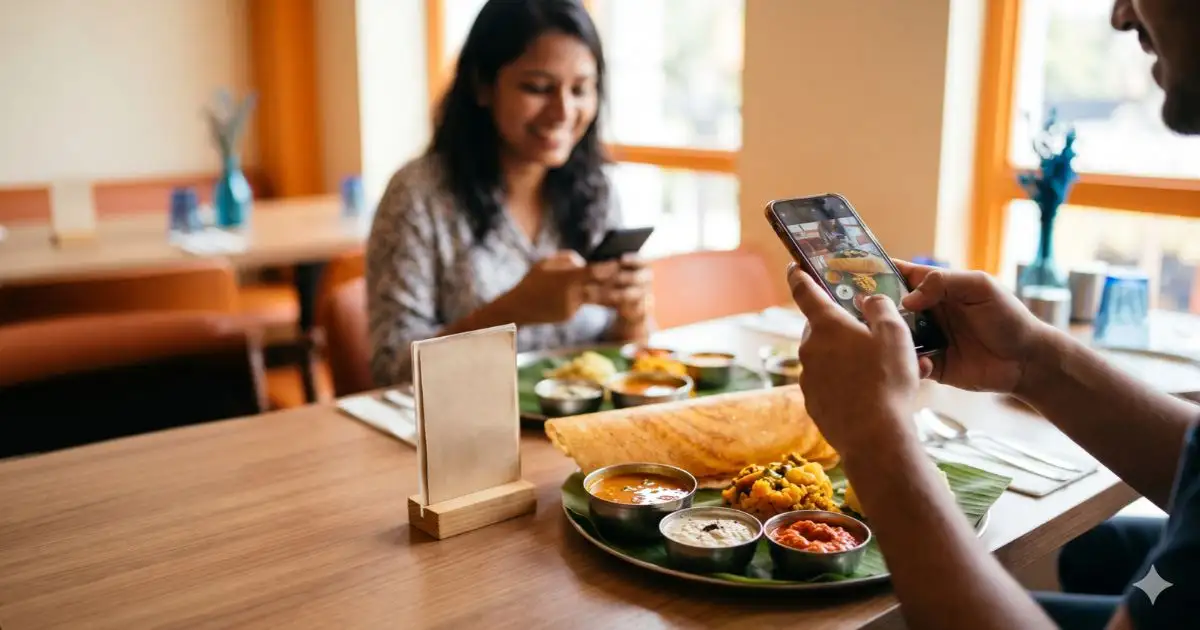
- People check photos and ratings on their phone before they choose where to eat, so your customers’ content is often your first impression.
- Start with two places: Instagram for discovery and your Google Business Profile for turning interest into a visit.
- Make sharing easy: one photo-ready corner, a QR code on every table and bill, and a clear “tag us” invitation.
- Ask every customer for a review. Google does not allow rewards for reviews or asking only happy customers.
- Label paid or free-meal collaborations clearly, ask permission before reposting, and answer every review.
What is user-generated content (UGC) for a restaurant?
User-generated content (UGC) for a restaurant is any photo, reel, story, review, rating or comment that a customer creates about your food, service or space. It is word-of-mouth marketing made public, searchable and shareable.
| Type of UGC | Where it appears | Why it helps your restaurant |
|---|---|---|
| Reviews and photos | Google Maps and Google Search | Shown when people search for places to eat nearby; ratings and photos influence who gets the click. |
| Posts, reels and stories that tag you | Show real dishes and real crowds, and bring your restaurant to the friends of the person posting. | |
| Ratings and dish photos | Zomato, Swiggy and other food apps | Influence first-time orders and table bookings. |
| Recommendations in family and friends groups | Hard to measure, but often the final nudge to try a new place. |
Why does UGC bring more diners to a restaurant?
UGC works because people trust the experiences of other diners, and they check before they walk in. Recent research shows how much weight reviews and photos carry in restaurant decisions:
- BrightLocal’s 2026 survey of 1,002 US adults found that 97% read online reviews for local businesses and 41% always do, as reported by Duckhub.
- A December 2024 Chatmeter survey of 1,083 US adults found that 92% look at photos in reviews at least sometimes, and about half look for reviews that include photos.
- A 2024 YouGov study across 17 markets found restaurants and bars top the list of categories where people regularly use online reviews (43%).
- A Harvard Business School study of Yelp data, summarised by Duckhub, linked one extra star to roughly 5 to 9% more revenue for independent restaurants.
Most of these studies are from the US. The habit they describe, checking photos and ratings on a phone before choosing a place, is easy to test in your own restaurant: ask new guests at the billing counter how they found you.
How do you get customers to create and share content about your restaurant?
Make sharing easy, give people something worth posting, and ask everyone. These eight ideas work for cafés, family restaurants, biryani shops and fine dining alike.
1. Create one photo-ready corner
A themed selfie station gives guests an obvious place to take a photo. Use good light, a clean wall or local artwork, and add your handle and hashtag in small, tasteful lettering. Place it near the tables, not at the entrance, so it does not block the door. For example, a Coimbatore café could paint a mural of local landmarks for guests to pose with.
2. Put a QR code on every table and bill
A QR code that opens your Google review page, and another for your Instagram profile, removes the effort. Test both on a phone, keep the wording short (“Loved your meal? Tell others”), and train staff to mention it politely to every table.
3. Run a “tag us to be featured” spotlight
Choose the best customer photo or reel each week and share it with credit. Add a small “Wall of Fame” in the restaurant or a gallery on your website. Message the guest first to ask permission, and tell them when the feature goes live.
4. Host a dish-naming or recipe contest
Ask followers to suggest a name for your next special, or vote between two versions. Publish simple rules (dates, prize, how the winner is chosen) and keep the prize small, such as a dessert or a family meal.
5. Add a friendly food challenge
A big-platter or spice challenge gives guests a story to post. Keep it safe and waste-free: let a team share, allow takeaway for leftovers, set a clear time limit, and never pressure anyone to finish.
6. Invite a local creator or loyal guest to take over your Stories
A one-day takeover brings a fresh voice and a new audience. Agree the content in advance, and label the collaboration if you give a free meal or payment (see the rules below).
7. Turn reviews into content
Share positive reviews as Stories, answer questions that guests ask in comments, and embed your best Google reviews and photos on your website. Quote reviews accurately, and do not edit what the guest wrote.
8. Follow up on WhatsApp
For guests who gave you their number for this purpose, send a thank-you message the next day with your review link. Send it to every guest, not only those who seemed happy.
What are the rules on incentives, reviews and influencers in India?
You may encourage reviews and posts, but you may not buy good Google reviews, hide bad ones, or hide paid promotions. This table summarises the main points; it is general information, not legal advice, so check the current policy pages.
| Area | Do | Don’t |
|---|---|---|
| Google reviews | Ask every customer for a genuine review. | Offer discounts, free dishes or any benefit for a review, ask only happy customers, or set review quotas for staff. See Google’s Maps policy. |
| Negative reviews | Reply politely and offer to fix the problem offline. | Offer a reward to have a review changed or removed, or discourage guests from posting negative feedback. |
| Fake or AI-written reviews | Collect real reviews from real guests. | Write, buy or generate reviews. In the Chatmeter survey, 53% of consumers said a review that looked AI-generated made them distrust it. |
| Instagram contests | Publish clear rules: dates, prize, how the winner is chosen. | Make a Google review a condition of entry. |
| Creators and influencers | Label collaborations clearly (for example “Ad”, “Sponsored”, “Collaboration” or “Free gift”) when you pay or give a free meal, as the ASCI influencer guidelines require. | Hide the disclosure or rely only on a small hashtag at the end. |
| Reposting guest content | Ask permission and credit the creator. | Repost private or identifiable photos, such as children or other diners, without consent. |
What is a simple 30-day plan to start?
A realistic first month is one small action per week. You do not need a big budget or a large team.
| Week | Focus | What to do |
|---|---|---|
| Week 1 | Foundation | Complete your Google Business Profile (hours, menu link, categories, 20 or more real photos). Choose one hashtag. Print table QR codes. |
| Week 2 | Make it easy | Set up the photo-ready corner. Brief staff to invite every table to tag you and review. |
| Week 3 | Spark sharing | Run a dish-naming contest or a “tag us to be featured” week. Repost the best entries with permission. |
| Week 4 | Review and repeat | Compare new reviews, tags, calls and direction requests with Week 1. Keep what worked and drop what did not. |
How do you measure whether UGC is working?
Track a few numbers every month. If they rise after you start asking and featuring guests, your UGC effort is working.
| Metric | Where to find it | What it tells you |
|---|---|---|
| Calls, direction requests, website clicks | Google Business Profile performance | Whether people who find you on Maps take action. |
| New reviews per month and average rating | Google Business Profile, Zomato, Swiggy | Whether your asking routine is working. |
| Tagged posts and mentions | Instagram notifications and Tags tab | Whether guests share unprompted. |
| Saves, shares and profile visits | Instagram Insights | Whether your content is worth passing on. |
| “How did you find us?” answers | Billing counter or WhatsApp | First-hand proof from your own city and customers. |
What mistakes should restaurants avoid?
- Asking only happy customers. This is review gating and Google does not allow it.
- Rewarding Google reviews. Reward Instagram participation if you wish, never reviews.
- Reposting without permission. Ask first and give credit.
- Ignoring reviews. An unanswered complaint is public and permanent; a polite reply shows other diners how you treat guests.
- Sending visitors to a dead end. If your link in bio leads to a heavy PDF menu, you lose the diners you worked to attract.
Frequently asked questions about restaurant UGC
What is user-generated content for restaurants?
User-generated content (UGC) for restaurants is any photo, reel, story, review, rating or comment that a customer creates about your food, service or space. It lives on Google Maps, Instagram, Zomato, Swiggy and WhatsApp, and it works as modern, searchable word-of-mouth.
How can a small restaurant get more customer photos and reviews?
Make one corner or one dish worth photographing, put a QR code for your Google review page and Instagram handle on every table and bill, and ask every guest politely, not only the happy ones. Then repost the best content with permission so people see that sharing gets noticed.
Can I give a discount or a free dish for a Google review?
No. Google’s Maps policy bars businesses from offering payment, discounts or free goods in exchange for reviews, from selectively asking only happy customers, and from discouraging negative reviews. You may ask for genuine reviews. Rewards are fine for Instagram contests, as long as the rules are clear and no review is required.
Do I need permission to repost a customer’s photo or video?
Yes, ask first and credit the person. The customer who took the photo usually owns it. A short comment or direct message such as “May we feature this on our page?” is enough to start, and keep the reply as a record.
Which platform is best for restaurants in India?
For most independent restaurants, start with Instagram for discovery and a complete Google Business Profile for conversion, because people searching on Google Maps are ready to call, get directions or order. Add Facebook, YouTube Shorts or WhatsApp only if you can keep them active.
How should I reply to a negative review?
Reply publicly within a day or two, stay polite, thank the guest, acknowledge the specific problem, and offer to fix it offline. Never offer a reward to have a review removed or changed, because Google prohibits it, and never argue in the comments.
How long does it take to see results from UGC?
You can usually see early signals, such as more tagged posts and new reviews, within the first month of asking consistently. Steadier growth in calls, direction requests and bookings builds over a few months. Results vary by location, food and how often you post.
Next step: turn attention into bookings with a fast website
UGC brings people to your profile; your website helps them decide. A fast, mobile-friendly restaurant site should show a readable menu (not just a PDF), call, directions and WhatsApp buttons, your best reviews and photos, and structured data so Google and AI search tools can read your hours, menu and location.
BRUsoft builds hand-coded WordPress websites for businesses in Coimbatore and across India. To discuss a website for your restaurant, email bala@brusoft.in or visit brusoft.in.
Sources
- Duckhub: Restaurant Review Statistics 2026 (reports BrightLocal 2026 and the Harvard Business School Yelp study)
- Chatmeter: 2024 survey findings on how consumers research local businesses
- YouGov Business: Should restaurants and bars concern themselves with online consumer reviews? (February 2024)
- Google: Prohibited and restricted content, Maps user-generated content policy
- Advertising Standards Council of India (ASCI): influencer advertising guidelines
About the author: Bala is the founder of BRUsoft, a web development studio in Coimbatore, Tamil Nadu, with more than 20 years of experience building websites.
Read next
Social Media Strategies for Local Businesses
Are you an Audio freak? This is for you. An AI-crafted audio. Hey there! If you’re a local business owner…
Mastering Omnichannel Marketing: Creating Seamless Customer Experiences
Are you an Audio freak? This is for you. An AI-crafted audio. In today’s hyper-connected world, consumers interact with brands…
From Employees to Brand Ambassadors: How Small Businesses Can Transform Their Team into Their Biggest Advocates
In today’s competitive business landscape, brand loyalty and advocacy are more crucial than ever. While marketing campaigns and social media…